
"Code violation" and "code enforcement" get thrown around like they mean the same thing. They don't, and the gap between them is where the deal is.
A violation is the citation: the city wrote down that something on the property is wrong. Code enforcement is what happens next: the inspections, the deadlines, the fines, and eventually a lien. That process is a clock running against the owner, and the further it has run, the more pressure they are under. Pressure is the whole reason a distressed owner sells to an investor instead of listing with an agent.
I pull Seattle's code enforcement data every morning for my own deal sourcing. Here is what the enforcement side actually tells you, and why the stage a case has reached matters as much as the violation itself.
Code enforcement is the process a city uses to make an owner fix a code violation: inspect the property, issue a notice, set a deadline, and escalate with daily fines and property liens until it complies. The violation is the individual citation. Code enforcement is the machine that acts on it. For an investor, the violation tells you something is wrong. The enforcement stage tells you how badly the owner needs out.
The code enforcement process, stage by stage
Enforcement is not one event. It is a ladder, and every rung raises the cost of doing nothing. Here is how Seattle's runs, and most cities follow the same shape.
- A complaint comes in. Most cases start with a report, from a neighbor, a tenant, or a passing inspector. Seattle logs these in its open code violation dataset as code complaints and violations.
- An inspector confirms it. The city inspects. Seattle gives you two free inspections on a housing or land use complaint; after that, re-inspection fees start billing to the owner.
- A notice of violation goes out. If the inspector finds a real problem, the city issues a Notice of Violation. It names the code section, says what to fix, and sets a compliance date. In Seattle that window is usually 30 to 60 days.
- The deadline hits. This is the rung that matters most. Under Seattle's code, the violation is deemed to begin, for penalty purposes, on the date compliance was required. Miss it and the meter starts.
- Penalties accrue. Seattle's municipal code allows a civil penalty of up to $500 a day, per violation, from the compliance date until the property complies. A handful of violation types run higher, up to $1,500 a day.
- The city escalates. Unpaid penalties get referred to collections. A case that stays open can go to the Law Department for court action, and the city can abate the problem itself and bill the owner for the work, authority that in Washington traces back to the unfit-dwellings statute, RCW 35.80.030.
- A lien attaches. Unpaid penalties and abatement costs are assessed against the property as a lien of equal rank with property taxes, entered onto the tax rolls. Now the cost is stuck to the property, not just the person.
That last rung is the one most investors miss, and it is the most important.
What each stage tells you about the owner
The violation type tells you what is physically wrong. The enforcement stage tells you how much the owner is feeling it. Same case, very different lead depending on where it sits on the ladder.
| Enforcement stage | What it means | Signal for you |
|---|---|---|
| Complaint filed, not yet inspected | Someone reported it; nothing confirmed | Weak. Watch it, don't work it yet. |
| Notice issued, inside the compliance window | Owner's been told, still has time | Moderate. The clock just started. |
| Compliance date passed, still open | Owner blew the deadline, penalties running | Strong. This is the sweet spot. |
| Referred to collections or the Law Department | Owner ignored it into a legal problem | Strong, sometimes messy. |
| Abatement done or lien recorded | City stepped in; cost is on the property | Strong, and now there's a number to work with. |
| Marked "in compliance" or closed | Owner fixed it or is fixing it | Weak. The pressure's off. |
The pattern is simple. An owner who is fixing the problem is not your seller. An owner who has let the deadline pass and is watching fines stack is exactly who you want to reach, before the city forces the issue and before the property lists.
The part that turns pressure into a sale
Here is the mechanic that makes enforcement worth reading closely: daily penalties and the lien they turn into.
Up to $500 a day, per violation, is a number that compounds. The city does not always assess the maximum, and penalties can be reduced when an owner finally complies, so do not walk into a conversation quoting a scary total as fact. But the exposure is real, and the owner knows it. An owner sitting on three open violations that went past deadline two months ago is looking at a liability that grows every morning they do nothing.
Then it attaches to the property. Once unpaid penalties or the city's abatement costs get recorded as a lien, that cost has to clear when the property changes hands. It comes off the top of the seller's proceeds, or it becomes part of what you negotiate. Either way it is a number on the table when you make your offer, and it is one more reason the owner would rather be done than keep bleeding.
This is also why code enforcement finds deals a title search misses. An open violation racking up daily fines usually has not been recorded as a lien yet, so it will not show on a standard title report, but it is public in the city's enforcement data the whole time. You can see the pressure building before it ever hits the county recorder. The full legal basis for that is in are code violations public record?.
How to read enforcement status in the data
Seattle's open data exposes a status on every case: open, in compliance, closed, resolved. That one field does a lot of the sorting for you.
Open, past the compliance date, is the signal. That is an owner who was told, given a month or two, and still has not fixed it. "In compliance" is the opposite. It means the owner is actively working the problem, which reads a lot like a construction permit does: someone putting money into the property, not someone trying to walk away. I weight those near zero, the same way I treat construction violations as a weak or negative signal.
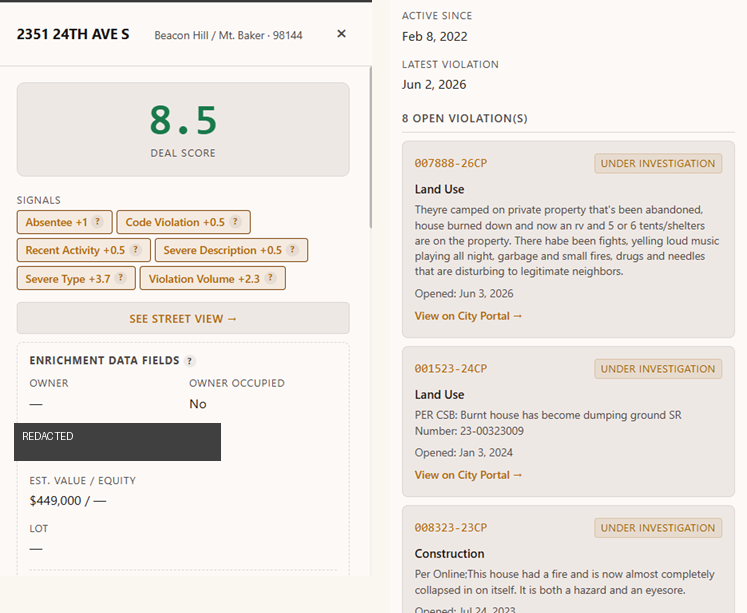
Read together, status plus time-open plus violation type is a distress gauge. A vacant-building case that has been open and past deadline for six months is a different animal from a weeds complaint filed last week, even though both show up as "code enforcement violations" in the raw data.
How investors work code enforcement leads
The workflow is the same one that works for any distress signal, with the enforcement stage as the sort key.
- Pull the open cases. Start with your city's code enforcement data. In Seattle's dataset as of September 2026, 10,695 cases sit at Under Investigation and 1,598 at NOV Issued, spread across thousands of properties, and the same shape holds in every city that publishes its caseload. King County writes the whole enforcement mechanism into Title 23 of its code for the unincorporated areas.
- Rank by stage, severity, and time open. Past-deadline and accruing beats fresh notice. Vacant, emergency, and land use beat cosmetic. Long-open beats brand-new. Turning those rules into one sortable number is what a distress score is for.
- Match each case to an owner. The enforcement record gives you the address, not usually a phone number. Pull the owner and mailing address from the county assessor or parcel record.
- Flag the absentee owners. A mailing address that differs from the property is the single best filter for motivation.
- Reach out at the pressure point. Contact after the deadline has passed and the fines are stacking, but before the city forces resolution. That window is where the conversations turn into deals.
Doing that by hand across a whole city is the tedious part, and it is what I built FlaggedLeads to handle for Seattle. It reads the city's enforcement data every morning, scores each property by how much distress is stacked on it, and maps the result. We are Seattle-first and expanding across Washington, not everywhere at once. The free Seattle map shows where the cases are so you can see the list forming, and you can browse it by neighborhood for Seattle, Bellevue, and Tacoma. The scoring, ranking, and owner data behind the workflow are what the full investor's guide to code violations walks through end to end.
Frequently Asked Questions
What is a code enforcement violation?
A code enforcement violation is a property problem a city has formally cited and is acting on: it has issued a notice, set a deadline to fix it, and can add daily fines and a lien until the owner complies. The violation is the citation; code enforcement is the process the city runs to make it get fixed.
What happens if you ignore a code enforcement violation?
The cost climbs. After the compliance deadline passes, cities assess civil penalties that accrue daily, up to $500 a day per violation in Seattle. Unpaid penalties get referred to collections, the case can go to court, and the city can fix the problem itself and bill the owner. Those costs are then recorded as a lien against the property, which has to be cleared when it sells. The full escalation ladder walks each rung in order.
What is the difference between code enforcement and a code violation?
A code violation is the individual citation, one recorded problem on a property. Code enforcement is the whole process the city uses to resolve it: inspection, notice, compliance deadline, fines, and liens. For investors, the violation tells you a property is distressed, and the enforcement stage tells you how much pressure the owner is under.
Do code enforcement violations create a lien on the property?
They can. Unpaid civil penalties and the city's abatement costs get assessed against the property as a lien, which in Seattle ranks equal with property taxes and goes onto the tax rolls. An open violation that is still accruing fines usually has not become a recorded lien yet, which is why enforcement data catches distress a title report misses.
Why do investors care about code enforcement violations?
Because the enforcement stage is a motivation gauge. An owner who has missed the compliance deadline and is watching daily fines stack toward a lien is under real, growing financial pressure, and the property is not listed yet. That combination, motivated owner plus off-market timing, is what off-market investors are hunting for.