
Search "distressed property list" and you will find a dozen companies ready to sell you one. PropStream, BatchLeads, ForeclosuresDaily, all packaging the same public data and charging $50 to $500 a month for it. Here is what they don't advertise: the records underneath those lists are free, and the version you build yourself is fresher and less picked over than the one two hundred other investors in your market just bought.
A distressed property list is a set of properties whose owners are under financial, legal, or condition-related pressure that makes a below-market sale likely. That pressure shows up in public records long before the property ever lists on MLS. Paid services aggregate those records and resell them. You can pull the same records yourself, for free, straight from the source.
Free list versus paid list: what you are actually paying for
A paid list saves you time. That is the honest pitch, and for some people it is worth it (motivated seller leads: buy or build weighs the four ways to pay). What you are buying is aggregation: someone pulled tax, foreclosure, and ownership data, matched it up, and put it in one export.
What you are not buying is an edge. The same list is sold to everyone. By the time you mail it, the owner has heard from a dozen wholesalers working the identical file. And the data is often weeks stale, because the vendor refreshes on their schedule, not the county's.
A free list you build yourself is the opposite. It takes work, but it is current to the day the records updated, and it is yours alone until you tell someone about it.
The free sources behind every distressed list
Every paid list is assembled from these. Here are the ones worth pulling yourself, roughly in order of signal strength. The full breakdown of all seven sources, with the tradeoffs of each, is in how to find distressed properties using public data.
- Code violations. The clearest sign of an overwhelmed owner: the city has an open case on the property. Free on most big-city open data portals, refreshed daily, Seattle's code violation dataset being a model example, and it is all public record.
- Vacant properties. An empty building is a motivated owner waiting to be found. There is no single vacant list to download, so you build one; the how-to is in vacant property list from public records.
- Tax delinquency. County treasurers publish delinquent-tax lists, usually for $50 to $200 or free online, and single-parcel status is free on portals like King County's. Two or more years behind is the threshold that matters.
- Pre-foreclosure filings. Notices of default and trustee-sale notices recorded at the county are public, required by statute in non-judicial states like Washington (RCW 61.24.040). Free to pull directly, though the search tools are usually rough.
- Probate. When an owner dies, the property enters probate at the county clerk. Lower volume, higher conversion, and most investors skip it.
What a good distressed list actually looks like
A raw export of five thousand addresses is not a list, it is a chore. A useful distressed list is ranked, so the properties with the most distress signals stacked on them sit at the top and you work down until your time runs out.
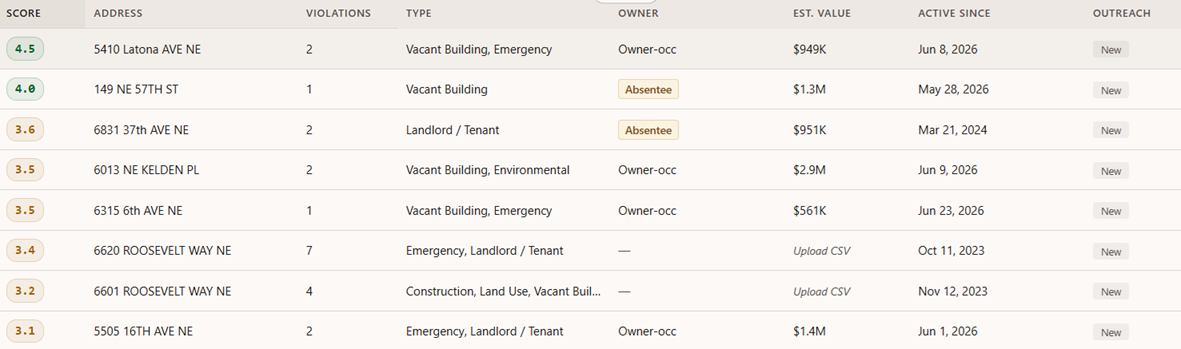
The properties near the top of a list like this have more than one thing wrong: a vacant-building case and an absentee owner and unpaid taxes. Those are the conversations that turn into deals.
How to build your own free distressed list
- Pick your city's freshest free source. For most people that is code violations on the open data portal. Pull the current open cases.
- Add a second free layer. Tax delinquency or pre-foreclosure. The properties that appear on both lists jump to the top.
- Match to owners. Use the county parcel or assessor record to attach an owner and mailing address to each address, or pull the county's whole roll at once with bulk owner data.
- Flag the absentee owners. A mailing address that differs from the property address is the single best filter for motivation.
- Rank and work the top. Skip trace the strongest twenty to fifty, then mail or call before anyone else has assembled the same picture.
Free versus paid, side by side
| Free (build it yourself) | Paid list | |
|---|---|---|
| Cost | Your time | $50 to $500 a month |
| Freshness | Current to the source | Refreshed on the vendor's schedule |
| Saturation | Yours until you share it | Sold to every investor in the market |
| Setup | You assemble and match the data | Exported and ready |
| Edge | High, if you do the work | Low, everyone has it |
Why the self-built list converts better
The math is simple. Response rates on distressed mail are low to begin with, and they collapse when the owner is on the tenth version of the same list. A list you built from fresh public records reaches owners earlier, before the pile of postcards, which is where the actual conversations happen. Stacking distress signals so the strongest leads rise to the top is the core of the distressed property playbook, and it is the reason a smaller, sharper list beats a bigger bought one.
Assembling and ranking that list by hand is the tedious part. That is what I built FlaggedLeads to do for Seattle: it pulls the city's violations every morning, 88,117 cases on 48,887 properties across seven Puget Sound markets as of September 2026, scores each property by stacked distress, and attaches owner data. The free Seattle map shows the raw violation data so you can see the list forming for yourself.
Frequently Asked Questions
Where can I get a distressed property list for free?
Straight from public records. Code violations, tax-delinquency lists, pre-foreclosure filings, and probate records are all free at the city or county level. You assemble them into a list yourself instead of paying a vendor to resell you the same data.
Is there a free distressed property list I can just download?
Not a single finished one. Governments publish the raw records for free, but they don't hand you a ranked, ready-to-mail list. You build that by pulling one or two free sources, matching owners, and sorting by how much distress is stacked on each property.
What is a distressed property list?
It is a set of properties whose owners are under financial, legal, or condition pressure that makes a below-market sale likely. The signals, code violations, unpaid taxes, foreclosure filings, vacancy, come from public records, which is why the list can be built for free.
Are paid distressed property lists worth it?
Sometimes, if you value the time savings and accept that everyone else has the same list. The tradeoff is saturation and staleness. A free list you build yourself is more work but reaches owners earlier and stays yours alone.
How do I make my own distressed property list?
Pull one free source (code violations are the easiest start), add a second free layer like tax delinquency, match each address to its owner through the county parcel record, flag the absentee owners, and rank by stacked signals. Work the top of the list first. The field spec, dedupe, and drop rules are in how to build a motivated seller list.